Brazilian physiotherapists say prolonged stillness, not neck angle, is the main home-office risk
UFC researchers Rodrigo Fragoso and Patrícia Collares say the widely circulated 27-kilogram neck-load estimate from a 2014 computer model is not confirmed by newer studies. A 2018 Brazilian study of 150 young adults found no association between bent-neck posture and neck pain. The main risk is staying in one position too long, and the UFC has released a free second volume of its home-office ergonomics manual in 2026.
The main event is the release of the second volume of the Manual de Ergonomia para o Uso de Dispositivos de Tela em Home Office by the PROERGON extension project at the Federal University of Ceará (UFC). The manual was launched in 2026 and is available free of charge from the UFC institutional repository. It can be shared without changes and without commercial purposes, provided the source is cited. The first volume was published in 2020 during the covid-19 pandemic.
The manual’s central recommendation is that the best posture is the next one. Physiotherapists Rodrigo Fragoso, vice-coordinator of PROERGON, and Patrícia Collares, professor in the UFC Department of Physiotherapy and project coordinator, say the key health risk is remaining still in the same position for long periods, rather than a specific neck angle. Fragoso said people should change position when they notice fatigue, pain, or tingling.
The researchers also questioned the widely shared estimate that a forward-tilted neck carries a load of 27 kilograms. That figure comes from a November 2014 computer-model study by American spine surgeon Kenneth Hansraj of New York, published in Surgical Technology International. Hansraj estimated that an adult head weighing between 4.5 kilograms and 5.5 kilograms in a neutral position would impose about 12 kilograms of load at a 15-degree tilt and about 27 kilograms at a 60-degree tilt. Fragoso said the model was intended to estimate neck-muscle effort but has been treated as absolute truth, and that translating a computational model to a human body is not always feasible.
A 2018 study published in the European Spine Journal supports this scepticism. Gerson Moreira Damasceno and five other researchers assessed 150 young people aged 18 to 21 from a public high school in Rio de Janeiro while they typed messages on a mobile phone. Neck posture was observed through participants’ own perceptions and physiotherapists’ evaluations. The study found no association between a bent neck and neck pain, nor with pain frequency.
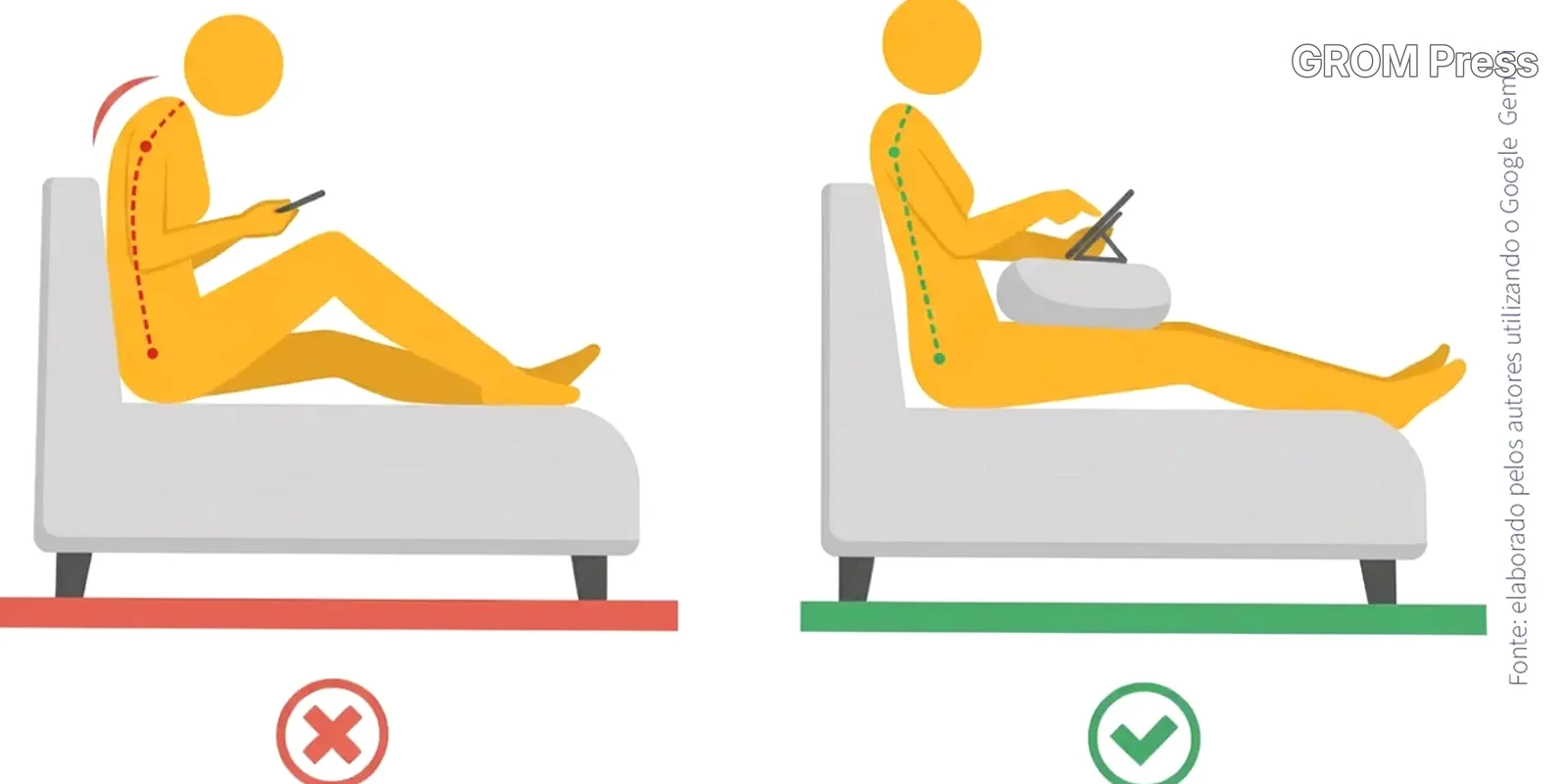
The manual includes practical recommendations for home workstations. The top edge of the screen should be at eye level. For a notebook, the screen should be raised with a stand, books, or a firm box, and a separate keyboard and mouse should be used. The screen distance should be where a closed fist reaches when the arm is extended forward. Shoulders should be relaxed, elbows close to the body and supported on the table or chair armrest, with straight wrists. A cushion or rolled towel at lumbar height helps maintain the natural spine curve. The chair should be adjusted so feet rest on the floor; if they do not reach, a footrest, stool, or box should be used. Lighting must not cause glare on the eyes or the screen. For two screens, the main screen should be directly in front and the second to the side, angled up to 15 degrees. For mobile phones, the head should remain neutral and the device at eye level. Clothing should be light but convey seriousness and concentration.
The report also notes the labour context. Ergonomic conditions in workplaces follow Regulatory Standard 17 (NR-17) of the Ministry of Labour and Employment. For telework, article 75-E of the Consolidation of Labour Laws (CLT) requires employers to instruct employees expressly and ostensively on precautions to prevent occupational diseases and accidents. Employees sign a term committing to follow those instructions. Fragoso said ergonomics means adapting the environment to the worker, not the reverse.
The findings were presented in episode 48 of the Ajudante Digital technology podcast by Radioagência Nacional, which opens its sixth season. The radio version aired on Tarde Nacional on Rádio Nacional. The extended 13-minute version is available on the Radioagência Nacional website. The podcast is created and presented by journalist Leyberson Pedrosa and has been on air since October 2024. Episode 49 will cover breaks, eye-rest rules, and three seated stretches described by Rodrigo Fragoso. It will air on Tarde Nacional on 7 December and reach platforms on the following Thursday, 10 December.
Source: GROM.PRESS